The Mysterious Sumerians
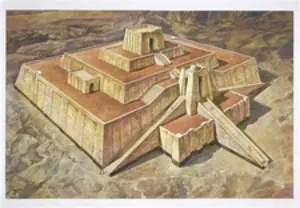
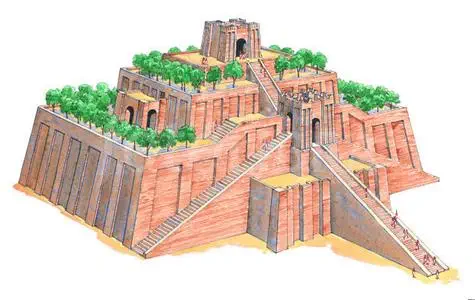
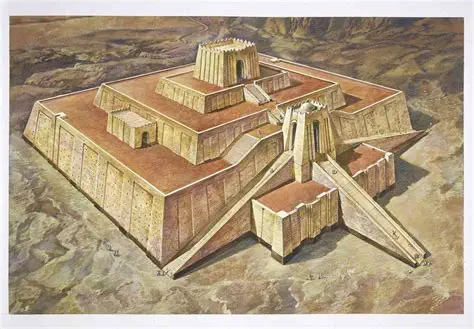
Some say that the ziggurats built by the
Sumerians and then later the Babylonians
are the inspiration for the tale of the Tower
of Babel.
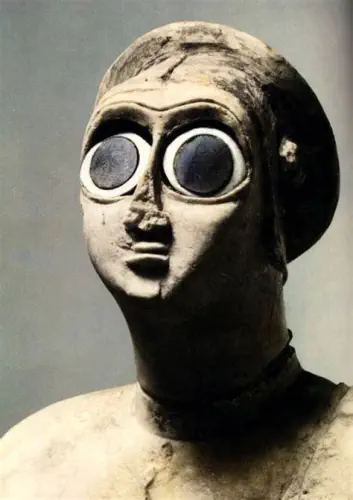
Sumerians have intrigued archeologists and lay people ever since the discovery of the first
ruins in the 19th century. Due to their profound influence on western culture, wild theories
abound about their extra-terrestrial influence if not outright
origin (example:
https://galacticanthropology.org/2022/11/28/the-
chronology-of-the-anunnaki-era/).
The simple fact is, archeologists do not know where the
Sumerians originated from. Their language was an isolate,
meaning there are no other known related languages, past or
present.
Some archeologists argue that the Sumerians were indigenous
to the area in which their culture thrived. Others posit that
they migrated from Anatolia, Central Asia, the Zagros (Iran)
or Bahrain (known as Dilmun in Sumer).
Regardless of origin, the impact of the Sumerians on future
civilizations is immense. Much of what we take for granted in
the modern day has rudimentary roots in Sumer. One could
argue that civilization began in the Sweetland - the area
between the modern Euphrates and Tigris rivers.
![[x]](index_html_files/close.png "Close")
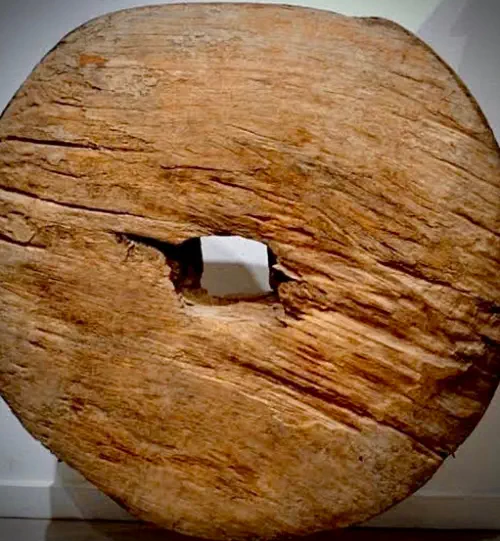
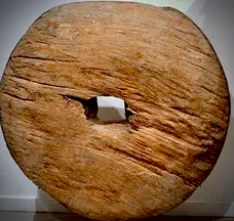
What would we do without the
wheel?
Although it’s possible the wheel
might have first been used in
Turkiye or in Central Europe,
certainly it was the Sumerians
who developed it fully into
wheeled transportation by adding
axles.
Probably the Sumerians started
out by creating a potters wheel.
which greatly accellerated the
production of pottery (see section
on pottery). Someone then had
the brilliant idea that two wheels
and an axle could be attached to a
platform to make a cart pulled by
an ox. The world has been on the
move ever since.
The Wheel
Farming
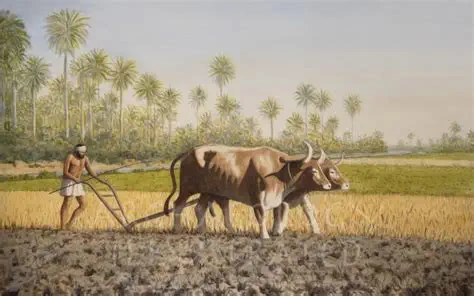
While farming pre-dates the Sumerians, the
Sumerians took agriculture to a level far beyond their
predecessors using vast organized irrigation systems,
and possibly inventing the plow. No contemporary
culture developed farming to the level that Sumer
did. Indeed, as a result of their vast irrigation
systems, agricultural products and byproducts
became a major trading resource, which in turn led
to the rise of the world’s first cities. By 2700 BCE
Uruk grew to an estimated population of 50,000
inhabitants.
Writing
You’re reading. That is a new phenomenon.
Archeologists estimate that humans (homo sapien
sapien) have existed for roughly 300,000 years.
Although cave art and symbols are thought to be some
form of communication, written communication is
estimated to be only about 5,500 years old.
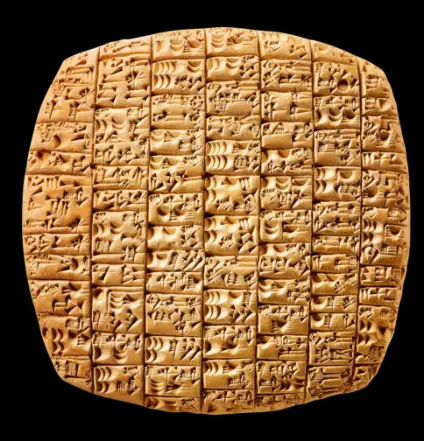
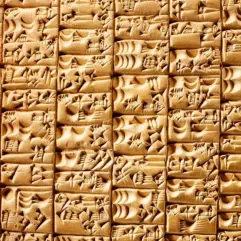
Most historians believe it was the Sumerians that
developed the first writing, starting with pictographs
and evolving into cuneiform as depicted in this tablet.
Influenced by the Sumerians, the ancient Egyptians
soon developed their own form of writing known as
heiroglyphs.
Writing began as an accounting system, a method of
tracking trade and taxes. But over decades, it morphed
into a full fledged writing system, capable of
expressing human thought and emotion. Successor civilizations adapted cuneiform to their
languages and the writing form lasted 3,000 years - long after the Sumerian language died out.
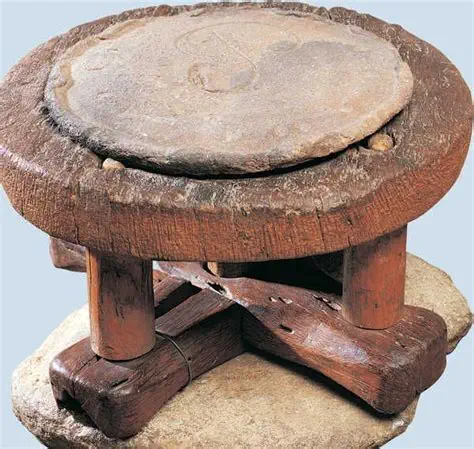
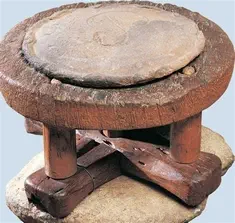
Although the Sumerians didn’t invent
pottery, they most likely invented the
potters wheel, which allowed for the
specialized labor of pottery
manufacturing. Mass manufacturing led
to significant trade volumes with those
cultures that were less advanced.
The potters wheel in turn was likely the
inspiration for creating a wheel and axle
for transport, one of the greatest
inventions of all time.
Potter’s Wheel
Metallurgy
The Sumerians invented the Bronze Age, full stop,
distinguishing themselves from the neolithic cultures
surrounding them. No longer dependent on animals or
plants, or chipping rock, Sumerians learned how to melt ores
to create tools, weapons and fashion jewelry. It was the leap
civilization needed to emerge from the Stone Age. Along with
writing, the wheel, and the building of true cities historians
can safely say that civilization has begun.

Science
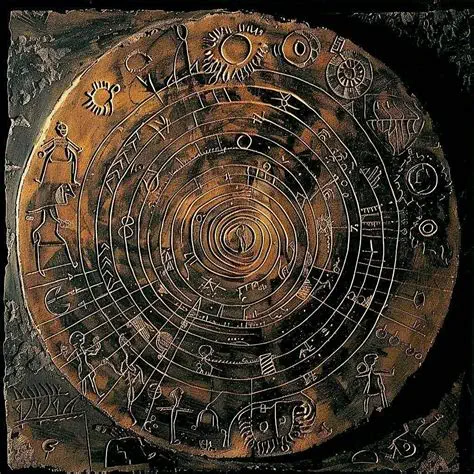
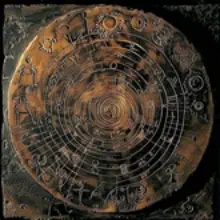
There are sixty seconds in a minute. Sixty minutes in
an hour. 360 degrees in a circle. What do these have
in common? Base 60 (sexagesimal number system).
The Sumerians used base 60 instead of base 10 like
we do. But we continue to use Base 60 for measuring
time and measuring circumference. The Sumerians
can be credited with developing geometric concepts,
calculating area and multiplication tables. In
addition, they tracked the movement of the stars and
planets and laid the groundwork for the zodiac
system.
Impact on Western Culture
It’s irrefutable the tremendous influence that
ancient Greek society has had on western
civilization (hello democracy). But what influenced
the Greeks? Though indirect, passed on from
successor cultures, the Sumerian influence of
ancient Greece is also undeniable.
Sumerians pioneered writing, mathematics,
astronomy, and astrology, all of which later shaped
Greek intellectual traditions. Greek scholars in the
Classical and Hellenistic periods studied
Mesopotamian astronomical records and
mathematical methods, especially after increased
contact via Persia and Alexander’s conquests.
Scholars note that there are similarities between Homer and the Epic of Gilgamesh, including a
heroic king, quests for fame (immortality), and wisdom.
And let’s not forget the gods. Aphrodite, goddess of love, probably derived from the goddess
Astarte, goddess of love and war in the Levant, which in turn derived from Ishtar, goddess of love
and war in Akkadia/Babylon, which in turn derived from Inanna, goddess of love and war in Sumer.
The Sumerian god Enlil, storm god and god of the bitter sea, incorporates attributes of both the
storm god Zues and the sea god Poseidon.
We are well versed in the city-states of Greece (Athens, Sparta, Corinth, Thebes, etc.) where each
developed their own temple-centered administration, developed their own legal codes and practiced
complex urban planning. But city-states originated in Sumer (Uruk, Ur, Kish, Eridu etc.).
So too, much of the Judeo-Christian and Islamic worlds inherited much from Sumerian culture,
starting with the creation myth. The Sumerian influenced and later Akkadian/Babylonian story of
Enuma Elish describes creation emerging from primordial seas via divine intervention, while in
Genesis, creation emerges from a black, formless desolation.
Certainly the story of The Flood originated in Sumeria (complete with divine warning, wiping out of
humans except a chosen one, birds sent to find land). The heavenly land of Dilmun of Sumerian
mythology mirrors the Garden of Eden, while the creation of humans from clay is parallel to the
creation of Adam. The Tower of Babel is thought by scholars to have originated from the building of
first Sumerian and later Babylonian ziggurats.
The Mysterious Sumerians
Some say the tale of the Tower
of Babel was inspired by the
ziggurats built by the
Sumerians and later the
Babylonians.

Who were the Sumerians?
Sumerians have
intrigued archeologists
and lay people ever
since the discovery of
the first ruins in the
19th century. Due to
their profound
influence on western
culture, wild theories
abound about their
extra-terrestrial
influence if not
outright origin
(example:
https://galacticanthropology.org/2022/11/28/the-
chronology-of-the-anunnaki-era/.
The simple fact is, archeologists do not know where the
Sumerians originated from. Their language was an
isolate, meaning there are no other known related
languages, past or present.
Some archeologists argue that the Sumerians were
indigenous to the area in which their culture thrived.
Others posit that they migrated from Anatolia, Central
Asia, the Zagros (Iran) or Bahrain (known as Dilmun in
Sumer).
Regardless of origin, the impact of the Sumerians on
future civilizations is immense. Much of what we take
for granted in the modern day has rudimentary roots in
Sumer. One could argue that civilization began in the
Sweetland - the area between the modern Euphrates
and Tigris rivers.
The Wheel
What would we do
without the wheel?
Although it’s possible
the wheel might have
first been used in
Turkiye or in Central
Europe, certainly it was
the Sumerians who
developed it fully into
wheeled transportation by adding axles.
Probably the Sumerians started out by creating a
potters wheel. which greatly accellerated the
production of pottery (see section on pottery). Someone
then had the brilliant idea that two wheels and an axle
could be attached to a platform to make a cart pulled by
an ox. The world has been on the move ever since.
Farming
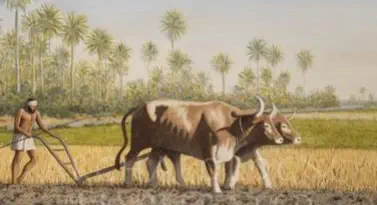
While farming pre-dates the Sumerians, the
Sumerians took agriculture to a a level far beyond
their predecessors using vast organized irrigation
systems, and possibly inventing the plow. No
contemporary culture developed farming to the
level that Sumer did. Indeed, as a result of their vast
irrigation systems, agricultural products and
byproducts became a major trading resource, which
in turn gave rise to the world’s first cities. By 2700
BCE, Uruk grew to an estimated population of
50,000 inhabitants.
You’re reading. That
is a new
phenomenon.
Archelogists estimate
that humans (homo
sapien sapien) have
existed for roughly
300,000 years.
Although cave art
and symbols are
thought to be some
form of
communication, written communication is
estimated to only be about 5,500 years old.
Most historians believe it was the Sumerians that
developed the first writing, starting with
pictographs and evolving into cuneiform as
depicted by this tablet. Influenced by the
Sumerians, the ancient Egyptians developed their
writing system known as heiroglyphs.
Writing began as an accounting system, a method
of tracking trade and taxes. But over decades, it
morphed into a full fledged writing system, capable
of expressing human thought and emotion.
Successor civilizations adapted cuneiform to their
languages and the writing form lasted 3,000 years
- long after the Sumerian language died out.
Writing
Although the
Sumerians didn’t
invent pottery, they
most likely invented
the potters wheel,
which allowed for
specialized labor of
pottery manufactoring.
Mass manufacturing
led to significant trade
volumes with those
cultures that were less advanced.
The potters wheel in turn was likely the inspiration for
creating a wheel and axle for transport, one of the
greatest inventions of all time.
Pottery
The Sumerians
invented the Bronze
Age full stop,
distinguishing
themselves from the
neolithic cultures
surrounding them. No
longer dependent on
animals or plants, or
chipping rock,
Sumerians learned
how to melt ores to
create tools, weapons
and fashion jewelry. It
was the leap
civilization needed to
emerge from the Stone
Age. Along with
writing, the wheel, and the building of true cities
historians can safely say that civilization has begun.

Metallurgy
Science
There are sixty seconds
in a minute. Sixty
minutes in an hour. 360
degrees in a circle. What
do these have in
common? Base 60
(sexagesimal number
system). The Sumerians
used base 60 instead of
base 10 like we do. But
we continue to use Base 60 for measuring time and
measuring circumference. The Sumerians can be
credited with developing geometric concepts,
calculating area and multiplication tables. In addition,
they tracked the movement of the stars and planets
and laid the groundwork for the zodiac system.
Impact on Western Culture
It’s irrefutable the tremendous influence that ancient Greek
society has had on western civilization (hello democracy). But
what influenced
the Greeks?
Though indirect,
passed on from
successor
cultures, the
Sumerian
influence of
ancient Greece is
also undeniable.
Sumerians
pioneered writing, mathematics, astronomy, and astrology, all
of which later shaped Greek intellectual traditions. Greek
scholars in the Classical and Hellenistic periods studied
Mesopotamian astronomical records and mathematical
methods, especially after increased contact via Persia and
Alexander’s conquests.
Scholars note that there are similarities between Homer and
the Epic of Gilgamesh, including a heroic king, quests for fame
(immortality), and wisdom.
And let’s not forget the gods. Aphrodite, goddess of love,
probably derived from the goddess Astarte, goddess of love and
war in the Levant, which in turn derived from Ishtar, goddess
of love and war in Akkadia/Babylon, which in turn derived
from Inanna, goddess of love and war in Sumer.
The Sumerian god Enlil, storm god and god of the bitter sea,
incorporates attributes of both the storm god Zues and the sea
god Poseidon.
We are well versed in the city-states of Greece (Athens, Sparta,
Corinth, Thebes, etc.) where each developed their own temple-
centered administration, developed their own legal codes and
practiced complex urban planning. But city-states originated in
Sumer (Uruk, Ur, Kish, Eridu etc.).
So too, much of the Judeo-Christian and Islamic worlds
inherited much from Sumerian culture, starting with the
creation myth. The Sumerian influenced and later
Akkadian/Babylonian story of Enuma Elish describes creation
emerging from primordial seas via divine intervention, while in
Genesis, creation emerges from a black, formless desolation.
Certainly the story of The Flood originated in Sumeria
(complete with divine warning, wiping out of humans except a
chosen one, birds sent to find land). The heavenly land of
Dilmun in Sumerian mythology mirrors the Garden of Eden,
while the creation of humans from clay is parallel to the
creation of Adam. The Tower of Babel is thought by scholars to
have originated from the building of first Sumerian and later
Babylonian ziggurats.